Month: December 2018

Eddie Logan Stakes at San Anita, Dec. 28

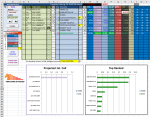
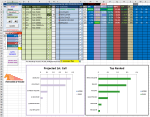
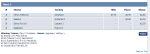
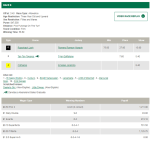
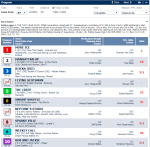
In the sole stakes race at San Anita today, the Handicap Wizard correctly predicted the winner of the $75K Eddie Logan at 1 mi. on the turf for two-year olds. Despite not having the best final speed estimate, Bob and Jackie rated highest with a 29% total winning probability due to stellar E1 and LP projections. Both the horses’s E1 and E1+LP estimates were crushing at 100% and 79.7%, leaving no doubt who the fastest horse in the field was. Its winning percentage of 13.5% was fair, given it was only the horse’s third race and that it had first and second place finishes, including a win at $53K level stakes. Tied for the second lowest post-time odds with Sparkville at 5-2 after 3-2 Rijeka, Bob and Jackie won this two-year old contest handedly, paying $7.80. Bob and Jackie was a slight underlay and fair choice at the 5-2 odds.


Race 2 and 3 at Aqueduct, Dec. 28

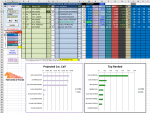
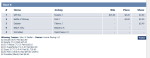
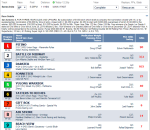
Races 2 and 3 at Aqueduct today offered a handicapping case study of when to take the favorite according to the model and when not to. In race 2, a $25K maiden claimer at 1 1/8 mi. on the dirt, Run for Boston was the leader in the field with a winning estimate of 49% versus post-time odds of 7-5. While the horse projected high total speed and had a dominant winning percentage, his speed figures looked vulnerable underneath at the E1 and LP level combined, where he was second at only 22%. On this basis, there was reason to be cautious about him. However, one horse who had comparatively good value according to E1+LP—a custom calculation only to be found in the Handicap Wizard—was Local Edition at 5-1, whose 26.8% by that metric was top in the field. His front running style also was advantageous on the sloppy track at Aqueduct, where he factored to be on the lead. This was exactly how the race went, with Local Edition finding his stride around the far turn after stalking two back to the half mile pole and by the final stretch he never looked back, paying $12.20 for the win.

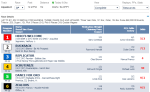
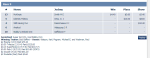
In the third race, a $68K maiden special weight race for three-year olds and upward at 1 mi., Hero’s Welcome was a solid 2-1 favorite or 36% winning percentage according to the model, which gave him some value against the 5-2 live odds price. Unlike Run for Boston above, there were no cracks in Hero’s Welcome underneath speed figures, projecting a 46.4% estimate by the E1+LP metric, which put his fair value closer to 1-1  than 5-2. With most of Hero’s Welcome’s speed coming late, the horse kept it close through the opening half mile, only trailing by 4 lengths, before he catapulted around the final turn in a five-wide bid to win by 3 1/2 lengths. In this case, the horse’s speed relative to his odds was more trustworthy and it paid off $7.70.


San Anita Opener, Dec. 26

McKinzie_Malibu_2018_615x400_orig

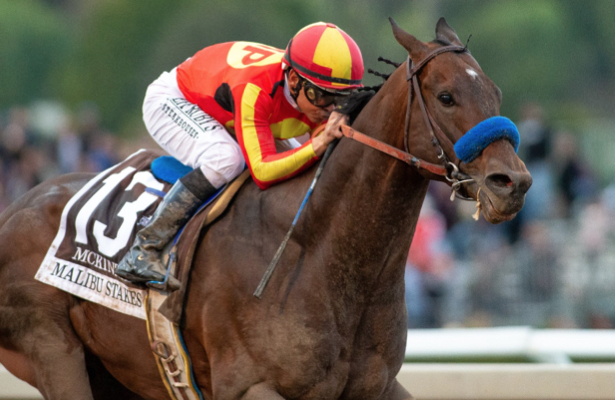
Racing fans had reason to be of good cheer today the day after Christmas with the opener of the San Anita track, featuring two premier races in the 8th and 9th with the San Antonio and Malibu Stakes at 1 1/16 mi. and 7f, respectively. The Malibu showcased several top horses, including Baffert trained McKinzie, who won the G1 Pennsylania Derby two back in September, Axelrod, Solomini and Ax Man. The Handicap Wizard gave McKinzie a sizable advantage with a total winning estimate of 36%, thanks to both a superior speed and class rating. This was close to the price the horse went off at 6-5. As the favorite, McKinzie bounced back from his disappointing showing in the Breeders Cup Classic in November to win by seven lengths, paying $4.40. Identity Politics ran a giant race to capture second at 13-1, but even at that those long odds the horse was expensive according to the model.

The San Antonio turned out to be a more competitive affair, with the Handicap Wizard calling it a close contest between Battle of Midway, Dabster and Gift Box. At 3-2 post-time odds versus a winning estimate of 35% by the model, Battle of Midway ran a perfect race and his heart out only to come up a neck short to Gift Box, who surprised at 6-1. That was close to how the model rated him at 13% win probability. Dabster came in third, while all three finished within one and a half lengths of one another.


Race 8 at Gulfstream, Sat. Dec. 22

While the market prices of the horses are supposed to reflect the public and track’s best guess who will win a race, the market on occasion can be dead wrong, as occurred at Race 8 at Gulfstream on Saturday, a $47K allowance race at 5f on turf for three-year olds and up. According to the post-time odds, #6 Razorback Lady at 35-1 had less than a 3% implied probability of winning. This had mostly to due with the horse’s recent performance, where it comparably had the lowest final speed figure in the field. However, three, four and five races back Razorback Lady had shown significant speed strength, posting three final speed figures in the mid nineties. As the Handicap Wizard accounts for the range of horses speed figures in its simulation, it judged the horse to have the highest potential speed with a winning speed estimate of 51%, albeit, accompanied by a somewhat high risk measure or Coefficient of Variation of 13%. With a total winning estimate of 30%, Razorback Lady was as large of an underlay as one will ever see using the Handicap Wizard program. Despite having higher than average risk, Razorback Lady proved to be the biggest winner on the card at Gulfstream on Saturday, paying $75 for a $2 wager. This race also shows that the program does not select just chalks, as Razorback Lady was the 2nd biggest long-shot on the board.


Race 9 at Aqueduct, Dec. 14

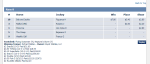
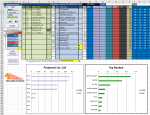
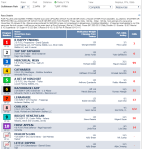
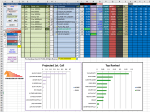
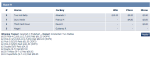
One of the features of the Handicap Wizard is a hybrid approach that incorporates the implied winning probabilities of the live odds of the horses into its core equations. Although the program is very thorough in its simulation, taking into account the final, early and late pace speed figures, and gauges winning percentage correctly, there is still information it does not reflect, which is, however reflected in the market odds. This is exemplified when a horse is getting much lower odds than its theoretical winning percentage, which happened today at Aqueduct in race 9 with #7 horse, Ouro Verde. Ouro Verde had the lowest odds in the field at 3-1, yet the model had the horse as its fourth selection with a total winning estimate of 8.80%. This made it a heavy overlay, but was suggestive of there being smart money on the horse, since the quantitative data did not support the low odds. The Handicap Wizard’s top selection was #9 Two Hot Betty with a winning estimate of 27.51%, equating to theoretical odds around 3-1 versus post-time odds of 4-1. In this contest between the model’s and the market’s view, which one was right? Answer: both were right. Two Hot Betty was the winner, while Ouro Verde came in second. The hybrid model also had the order of the tri-fecta correct with Third Card Down as its third selection. The difference between the winning estimates of the place and third cards was thin, but that was what was required to predict the order of a 113-1 tri-fecta, which the Handicap Wizard did using the live odds. The result is indicative of greater program accuracy than using the past performance data alone.