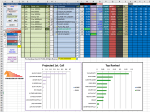
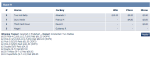
One of the features of the Handicap Wizard is a hybrid approach that incorporates the implied winning probabilities of the live odds of the horses into its core equations. Although the program is very thorough in its simulation, taking into account the final, early and late pace speed figures, and gauges winning percentage correctly, there is still information it does not reflect, which is, however reflected in the market odds. This is exemplified when a horse is getting much lower odds than its theoretical winning percentage, which happened today at Aqueduct in race 9 with #7 horse, Ouro Verde. Ouro Verde had the lowest odds in the field at 3-1, yet the model had the horse as its fourth selection with a total winning estimate of 8.80%. This made it a heavy overlay, but was suggestive of there being smart money on the horse, since the quantitative data did not support the low odds. The Handicap Wizard’s top selection was #9 Two Hot Betty with a winning estimate of 27.51%, equating to theoretical odds around 3-1 versus post-time odds of 4-1. In this contest between the model’s and the market’s view, which one was right? Answer: both were right. Two Hot Betty was the winner, while Ouro Verde came in second. The hybrid model also had the order of the tri-fecta correct with Third Card Down as its third selection. The difference between the winning estimates of the place and third cards was thin, but that was what was required to predict the order of a 113-1 tri-fecta, which the Handicap Wizard did using the live odds. The result is indicative of greater program accuracy than using the past performance data alone.


 Pro-Handicap Analytics