 By
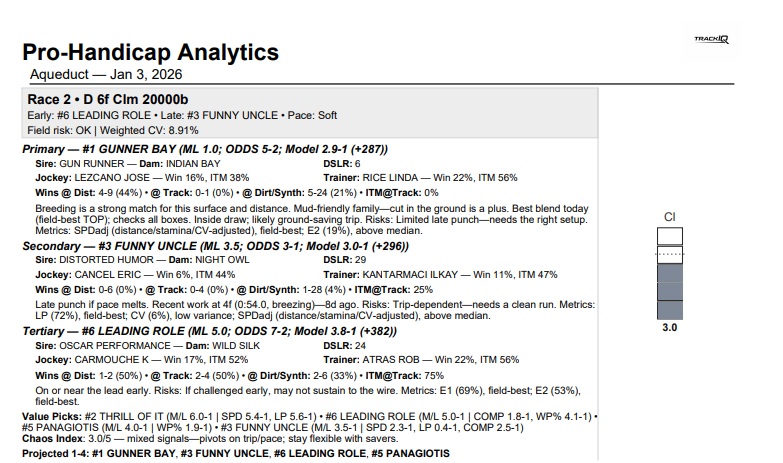
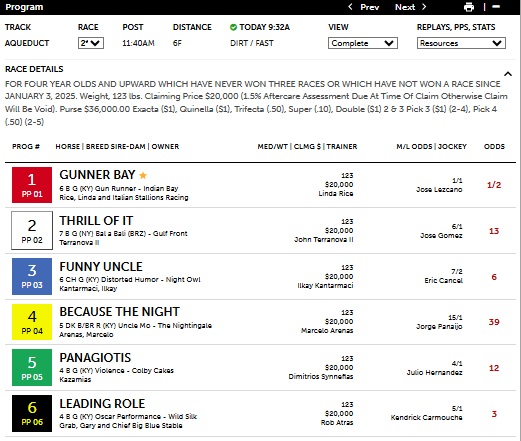
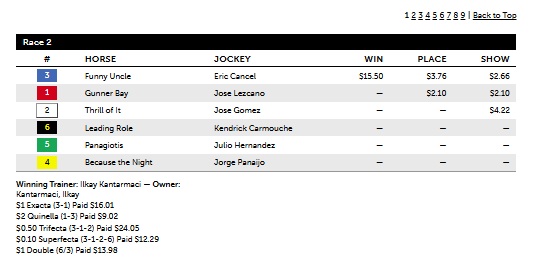
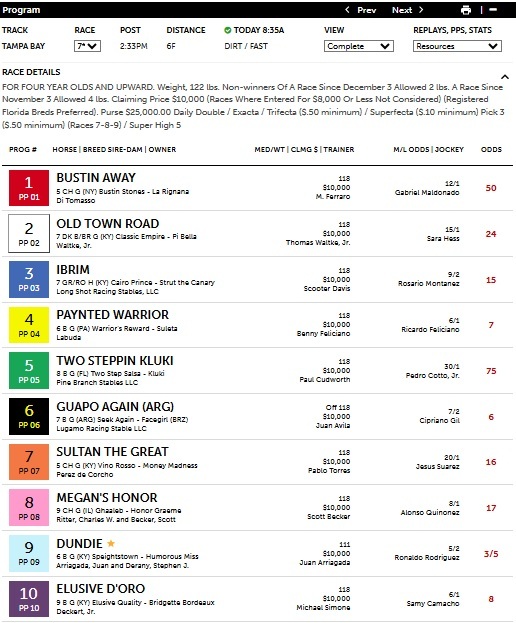
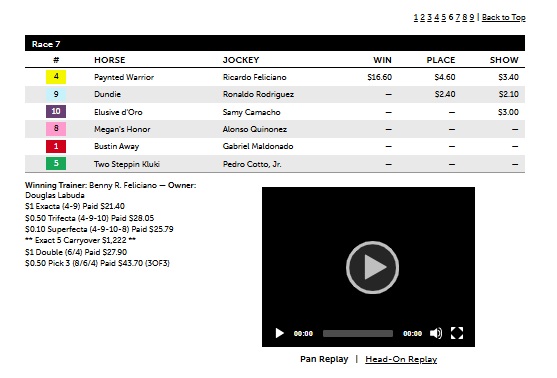
By One profitable strategy observed over months of Track-IQ analysis is the use of a “reverse wheel” or “part wheel” exacta, in which Secondary and Tertiary horses are wagered over an overpriced favorite (Primary). This approach represents a form of value arbitrage. Supported by accurate probability modeling and rigorous statistical analysis based on thousands of race simulations, Track-IQ is able to identify situations where the betting pool inefficiently prices outcomes due to the public’s tendency to over-bet favorites and systematically underprice horses just below the top tier. Two races in which this strategy proved effective were the 2nd at Aqueduct and the 7th at Tampa Bay, shown below.
Reverse wheels and similar constructions only become profitable when underlying probabilities are correctly estimated and explicitly contrasted against market-implied prices. Without that foundation, such structures quickly degrade into random coverage. Track-IQ’s advantage lies in quantifying true win equity, identifying compressed probability tiers, and isolating situations where market odds deviate meaningfully from those estimates. It is not risk-free arbitrage, but rather a persistent market inefficiency that generates positive expected value when exploited correctly.
In other words, the strategy works not because it fades the favorite, but because it reprices the race more accurately than the market. When public wagering overconcentrates on the most obvious outcome, Track-IQ’s statistical framework reveals where probability has not disappeared, but has instead been misallocated. The resulting bets are a consequence of disciplined analysis rather than intuition, and their consistency depends entirely on the quality of the probability model behind them.
To see the images below in full-resolution, click on the image and then on the encircled “i” in the bottom right hand corner. Scroll down and click on the full-size link in the bottom center.
Race 2 at Aqueduct
Race 7 at Tampa Bay
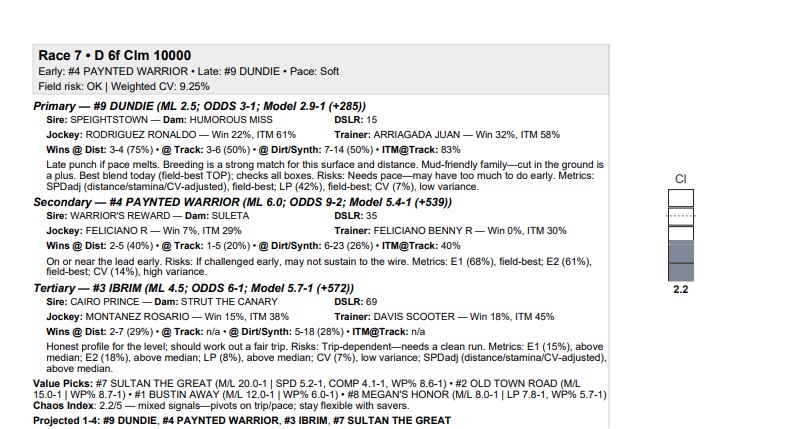

 Pro-Handicap Analytics