Month: January 2026

Value Picks Focus, Tues., Jan. 20, 2026

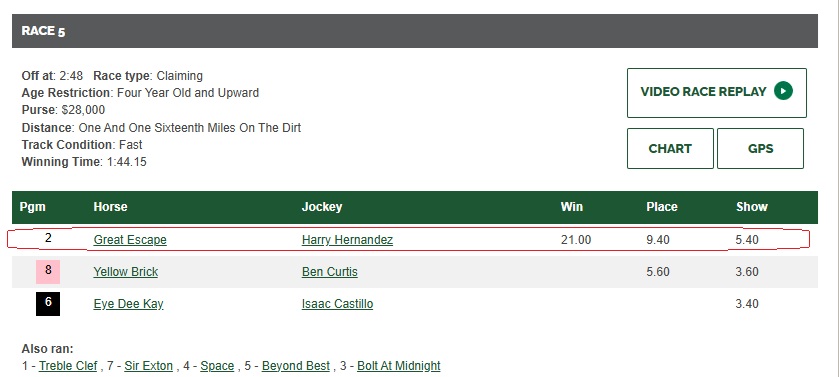
For those wondering how the Image-IQ Report can be used to spot value in horses other than with the obvious Model Odds values, there is a section below the Primary, Secondary and Tertiary selections called Value Picks, in which the user can see how specific metrics of the horse like SPD, E1, E2, LP, COMP and WP% are valued in terms of odds, which are converted from their win probabilities and historical win percentage. Ideally, the user is looking for horses that do not have just one metric, whose conversion to odds is below the live odds of the horse but multiple metrics below. Such a situation appeared in the 5th at the Fair Grounds yesterday, a $30K Clm at 1 1/16 mi. on the dirt with a projected hot pace, with the #2 horse, Great Escape at 9-1. The horse had three metrics with odds conversions not just below its live odds of 9-1 but also below its M/L of 9-2, including “LP 3.9-1, COMP 1.6-1, WP% 4.4-1”. What this means is that the horse’s late speed, COMP as the sum of its E1, E2 and LP probabilities from the simulation and historical win percentage, adjusted for stakes, had values that were below the M/L price. At 9-1, the market was treating Great Escape as a horse with 10% winning chances rather than a horse who has won 18-20% historically against this level of competition. Its COMP value of 1.6-1 indicated better than 2-1 strength for the horse on a speed component level in the aggregate.

In the race, Great Escape led from start to finish, winning by several lengths. The Primary selection in the Track-IQ report, #8 Yellow Brick, finished second. Great Escape paid $21 for the win and the $1 ex. paid $48.30. This result shows how a quick analysis of the value metrics of the horses can be used to spot a significantly undervalued horse. Pairing this type of discounted horse with the Primary selection is a reasonable exacta strategy that can be very profitable when the heavily discounted horse performs according to his projections and quantitative strength. This race is being mentioned because #2 Great Escape was actually taken in the race and is a real-life example.
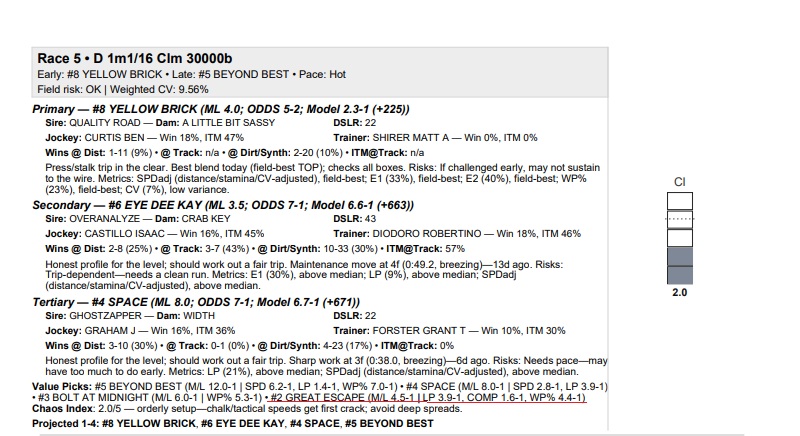
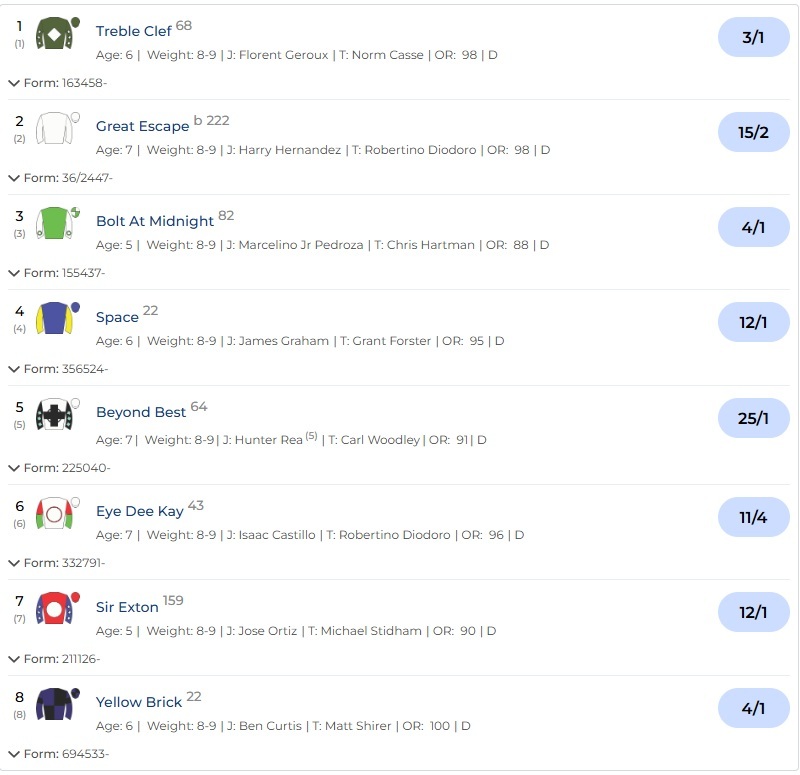
Equibase Notes on race 5 at FGX
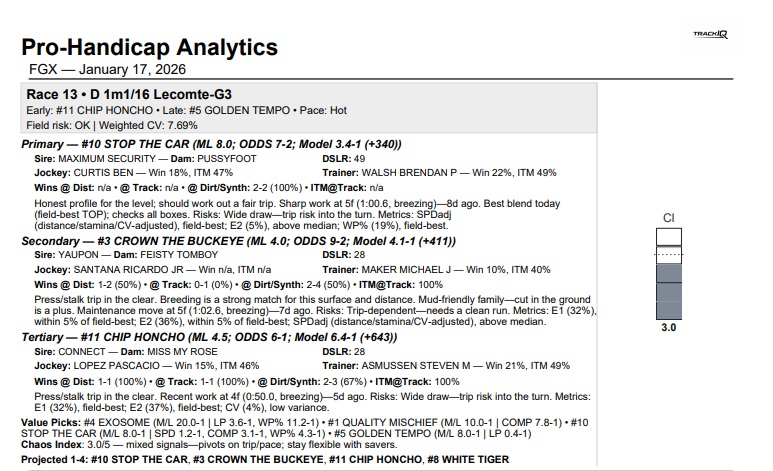
$250K G3 LeComte Recap at the Fair Grounds, Sun., Jan. 18

Here’s the explanation for why Golden Tempo won the LeComte yesterday over the horses that had been identified as Primary/Secondary/Tertiary in the Track-IQ framework.

Golden Tempo won the LeComte because the race unfolded far outside normal Fair Grounds dirt-route parameters, not because he was overlooked or misread. While the model correctly identified him as the strongest late runner, it did not elevate him into the top win tier under baseline assumptions, since horses dependent on late pace typically require help up front. What made this race different was the pace structure. The opening quarter of 23.72, followed by 47.11 to the half and 1:11.89 to three-quarters, created sustained early stress that developing three-year-olds rarely withstand over 1 1/16 miles at this venue.

That pressure didn’t merely soften the leaders—it dismantled second-call control entirely. Carson Street and Crown the Buckeye were forced into an unsustainable rhythm, and once that structure failed, the race flipped decisively to late flow. Golden Tempo, despite breaking slowly, saved ground under a patient ride and produced a last-to-first rally once the pace collapsed. He didn’t outrun expectations; the race exceeded the collapse threshold. Going forward, early Kentucky Derby prep races with comparable internal fractions will receive an alternate pace-stress analysis to reflect their elevated breakdown risk. This adjustment doesn’t replace the primary read or overvalue closers—it clarifies when race structure is fragile, and when late runners become legitimate win threats rather than contingent outcomes.

$250K LeComte Stakes Analysis, Fair Grounds, For Sat., Jan. 16

Here is the analysis for the G3 $250K LeComte Stakes at the Fair Grounds tomorrow, run at 1 1/16 mi. on the dirt for three-year-olds. It’s a Kentucky Derby prep race worth Derby 42 pts. total at Churchill, with 20 pts. going to the winner The Track-IQ report for FGX tomorrow includes analysis of the $175K G3 Louisiana Stakes at 1 1/16 mi. on the dirt for four-year-olds.

To see the above image in high-resolution, click on the image and then on the encircled “i” in the bottom right-hand corned. Scroll down and click on the link fur “full-size” in the bottom center.

Race Breakdown

Stop the Car (ML 8-1; MO 3.4-1) – Primary

Stop the Car appeals here because he looks like a three-year-old who is still on the upswing rather than one who has already shown his full hand. He’s undefeated, but the more important takeaway is how he’s won — without being fully extended or chasing inflated figures. That kind of profile plays well at Fair Grounds, where the dirt tends to reward horses who can carry their energy through the lane instead of those built purely on early speed. This race doesn’t require a dramatic leap forward; it typically rewards a horse who progresses naturally at this stage of the season, and his form suggests that kind of steady development.

The projected shape of the LeComte Stakes also works in his favor. Several contenders want to be involved early, while others are dependent on a pace collapse, leaving a tactical horse with flexibility in an advantageous position. Stop the Car doesn’t need the lead, but he also doesn’t need help from a meltdown, allowing him to stay in range while others sort themselves out. That versatility is often the difference maker in this race. The case here isn’t about flash or résumé; it’s about fit, timing, and upside, and those factors line up cleanly for him on this stage.

#3 Crown the Buckeye (ML 4-1; MO +4.1-1) – Secondary

#3 Crown the Buckeye merits serious consideration as a competitor because his profile speaks to durability and adaptability rather than flash. He has already shown he belongs in deeper waters, and that experience can matter in a race where several entrants are still figuring out what they are. His form suggests a colt who can handle pressure and stay on when the race turns from positioning to resolve, which is often where Fair Grounds separates pretenders from contenders. If the LeComte becomes a test of who can maintain rhythm and composure through the final three furlongs, Crown the Buckeye has already demonstrated that kind of staying power.

#11 Chip Honcho (ML 9-2; MO 6.41) – Tertiary

Chip Honcho fits a different but equally legitimate angle. His appeal lies in tactical intent and forward placement without being reckless, a combination that can prove dangerous in a prep where others are either committed speed types or need significant help late. He doesn’t require a perfect setup to be effective; instead, he can secure position, conserve enough energy, and make the field react to him turning for home. In the LeComte Stakes, that sort of race-shaping presence often keeps a horse involved longer than the betting suggests. Together, Crown the Buckeye’s stamina profile and Chip Honcho’s tactical edge give them credible paths to impact the outcome, even if the spotlight falls elsewhere pre-race.

Video on Stop the Car

Races 6 and 8 at Gulfstream, Fri., Jan. 16, 2026

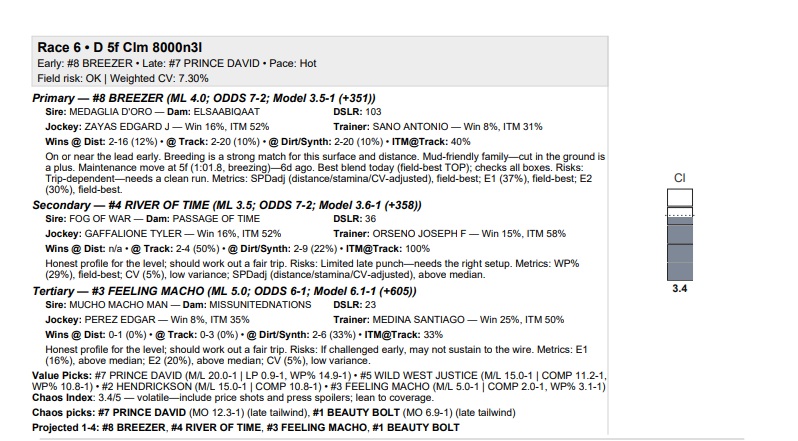
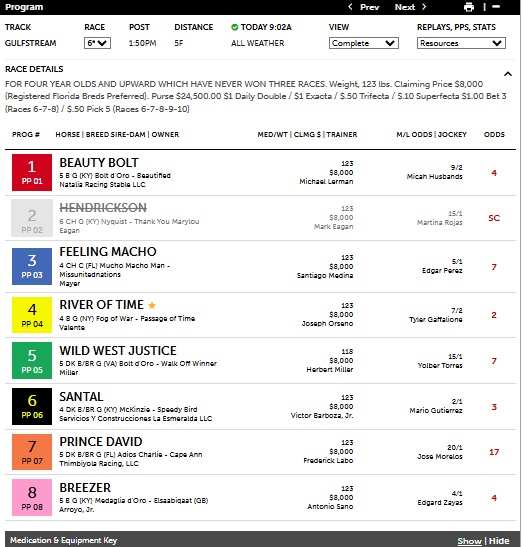
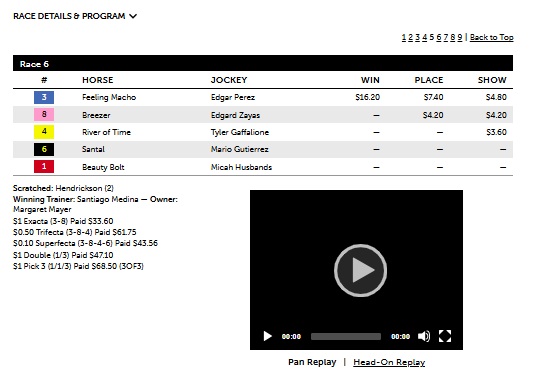
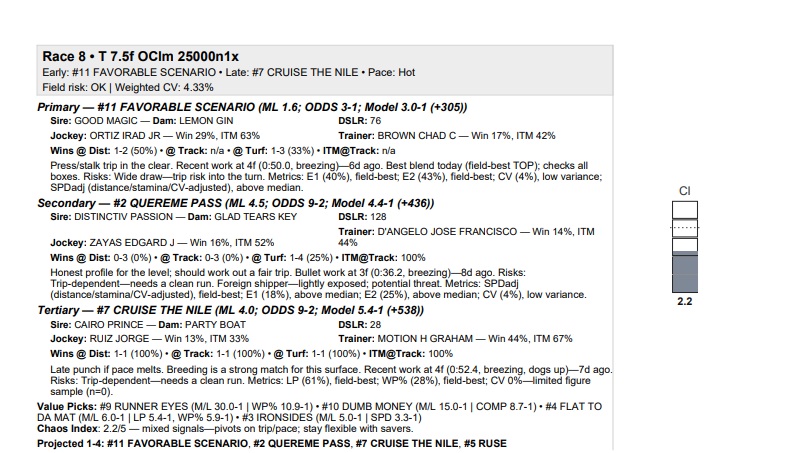
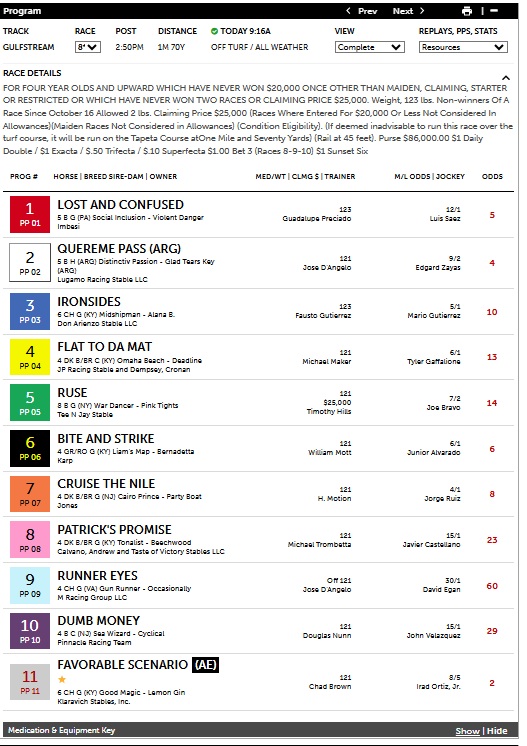
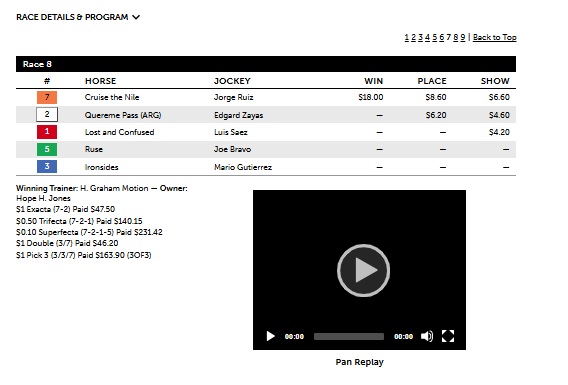
The Track-IQ report for GPX had a memorable winning day today, having the the tri-fecta horses in the 6th and the ex. in the 8th races at big odds. In the 6th, a CLM 8000 at 5f on the dirt, the AI-enabled and GPX customized program had the tri-fecta horses with its P/S/T selections of #8 Breezer at 4-1, #4 River of Time at 2-1 and #3 Feeling Macho at 7-1. The tri-fetca went 3-8-4 and paid $61.75 and #33.60 for the ex. And in the 8th race, an OClm 25000 at 7 1/2f off the turf, the program had the ex. order with its Tertiary and Secondary selections of #7 Cruise the Nile at 8-1 and #2 Quereme Pass at 4-1. The $1. ex. paid $44.75.

Race 6

Race 8