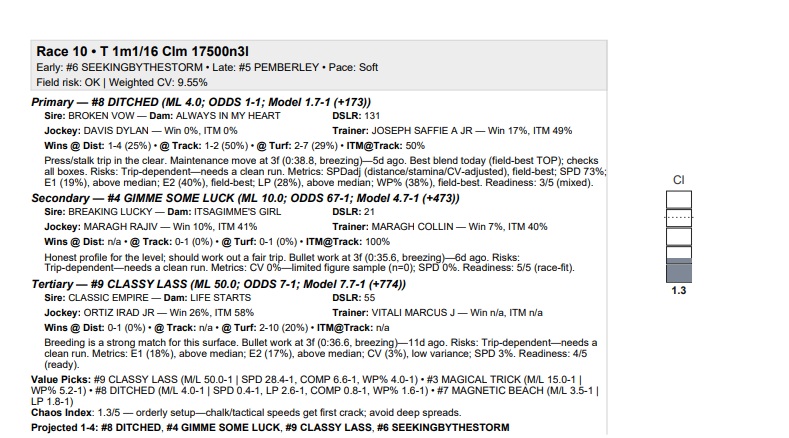
In horse racing, the central mistake most bettors make is believing that success comes from simply picking the right horse. The reality is governed by a different principle: the bettor cannot control the outcome of a race, only the price at which risk is purchased. Every race contains uncertainty—pace scenarios change, horses break poorly, trips go wrong, and countless variables influence the final result. Because of this uncertainty, the intelligent bettor must approach racing not as a guessing game but as a pricing problem. Track-IQ is built around this exact theorem. Instead of relying on intuition or narrative handicapping, the system estimates each horse’s probability of winning and converts those probabilities into fair odds. In doing so, it provides the bettor with the one piece of information that truly matters: whether the market price offered by the betting pools properly compensates for the risk being taken.
Most products in the horse racing marketplace never reach this level of analysis. They fall into three familiar categories: past-performance tools that provide raw data but no interpretation, tip sheets that offer selections without mathematical justification, or qualitative handicapping methods built around angles, trainer patterns, or narrative storytelling. None of these approaches fully address the fundamental theorem of wagering because they do not attempt to price the race probabilistically. Track-IQ begins where those systems end. By translating handicapping factors into probability and fair odds, it transforms racing analysis into a structured evaluation of risk. Selections matter only insofar as they help determine probability; the true advantage appears when those probabilities reveal that the betting market has mispriced a horse relative to its actual chances.
For this reason, Track-IQ is not simply another handicapping aid—it is a tool designed to price uncertainty. It applies the same reasoning a capable human handicapper would employ—evaluating factors such as days since last race (DSLR), performance variance, and contextual adjustments—but embeds those judgments within a probabilistic framework that converts them into measurable win probabilities and fair odds.
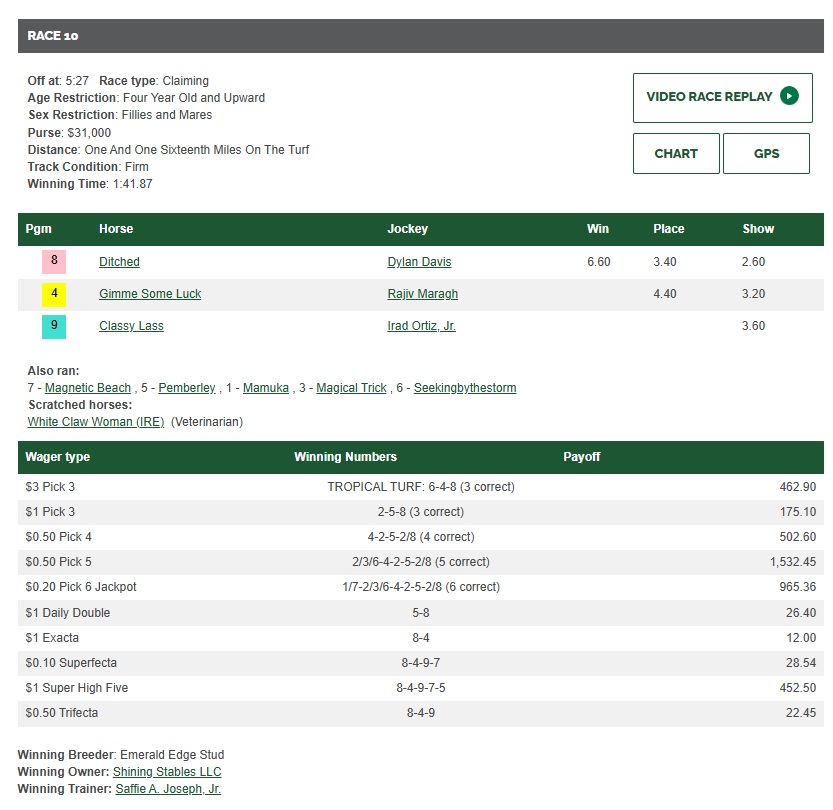
Over any single race the outcome remains uncertain, but across many races the mathematics of expectation assert themselves. By focusing on probability and price rather than guesswork, Track-IQ aligns perfectly with the governing theorem of wagering: the bettor cannot control who wins the race, but can consistently choose the right price at which to buy risk.
 Pro-Handicap Analytics