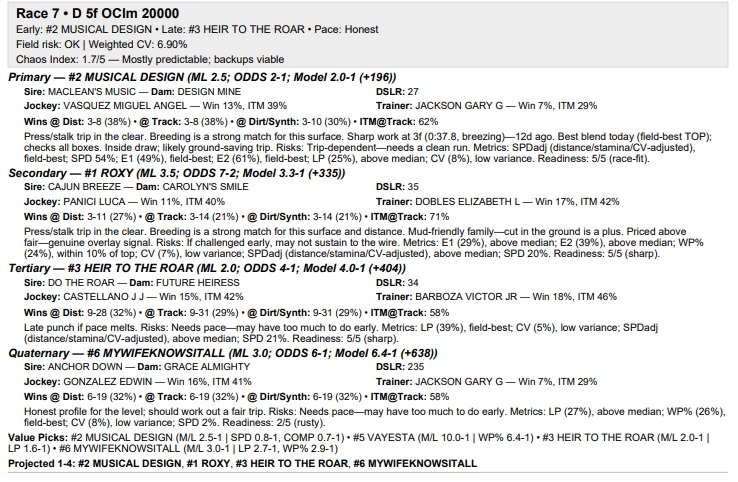
Pro-Handicap Analytics is proud to introduce the next generation of the Track-IQ Report. It now presents a complete four-horse structure—Primary, Secondary, Tertiary, and Quaternary—each with focused notes covering breeding, valuation, risk factors, key metrics, pace profile, and overall readiness—revealing how the race is likely to unfold. The Chaos Index has been elevated into its own row, paired with concise interpretation notes that instantly communicate the stability of the race and how much confidence to place in the rankings. Model odds are refined and capped for clarity, and the entire layout has been rebuilt for speed, alignment, and readability. The result is a cleaner, more complete view of race structure—one that turns complex analysis into immediate understanding and sharper decisions. Track-IQ: Next Gen. will be available beginning this Saturday and be part of the combined Report with the Overlay Lap. Below is a snapshot of race 7 at Gulfstream from today.
The “How To Use” guides for the Track-IQ and Overlay Map have been updated and expanded. They now include tables with definitions of key terms, along with additional information to help users better understand the content, mechanics, and structure of both tools when handicapping races.
Pro-Handicap Analytics today announced the release of the Overlay Map, a new visual companion to the Track-IQ Report designed to provide horseplayers with a clear overview of the entire field in every race. The Overlay Map is powered directly by the same probability engine used in the Pro-Handicap Wizard software, ensuring that the calculations remain consistent with the modeling that has driven the system for years. These calculations are pro-caliber analytics not found anywhere else,derived through Monte Carlo simulations of 1,000 races to estimate the true winning probabilities of each horse based on key performance factors.
One of the defining features of the Overlay Map is its color-coded shading, which highlights where the system’s core metrics—such as Final Speed (SPD), Early Pace (E1/E2), Late Pace (LP), and composite pace probabilities—translate into implied odds that are shorter than the horse’s Morning Line (M/L). When a metric suggests a horse should theoretically be priced lower than its Morning Line, the shading visually signals that the horse may be undervalued relative to that performance factor. This allows users to quickly identify which metrics indicate potential value before interpreting the live tote odds, using the calculations as a professional reference point while the betting market develops. Additionally, each horse name includes superscript class indicators: ᵘ denotes a horse moving up in class, while ᵈ denotes a horse moving down in class from its previous start.
The Overlay Map also includes a Flag column that highlights potential wagering opportunities. A Buy Signal appears when a horse’s WP% (historical win percentage adjusted for stakes) indicates the horse is trading at a discount relative to its Morning Line expectation. This suggests the horse’s historical win performance implies a shorter price than the Morning Line indicates. In addition, the map identifies Extreme Signals when the discrepancy between the system’s probability-derived odds and the Morning Line reaches a +8 odds differential or greater, pointing to situations where a horse may be significantly undervalued by the betting public.
The Track-IQ Report and the Overlay Map will now be combined into a single PDF, providing users with both probability rankings and value analysis in one integrated product. This combined report will be available for purchase on the website’s Purchase Page, giving users a comprehensive race analysis that shows which horses are most likely to win and where the betting market may be offering favorable prices. Together, the Track-IQ Report and Overlay Map create a disciplined framework for evaluating races through probability, price, and value.
Below is link to the Overlay Map for Gulfstream from March 8, 2026. Already in the 1st race, a $35K maiden race at 1 1/16 mi. on the turf, the Map identified #8 Overseer as being extremely discounted in terms of LP, flagging the horse as such in the Flag Column. It’s strong LP turned out to be the difference in the race, with Overseer winning at 30-1 odds. Also worth noting is that Overseer was the only horse moving up in class while all the other horse were moving down.
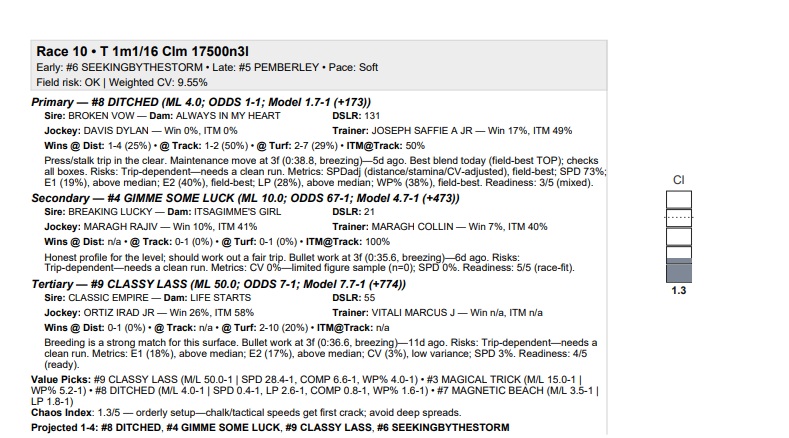
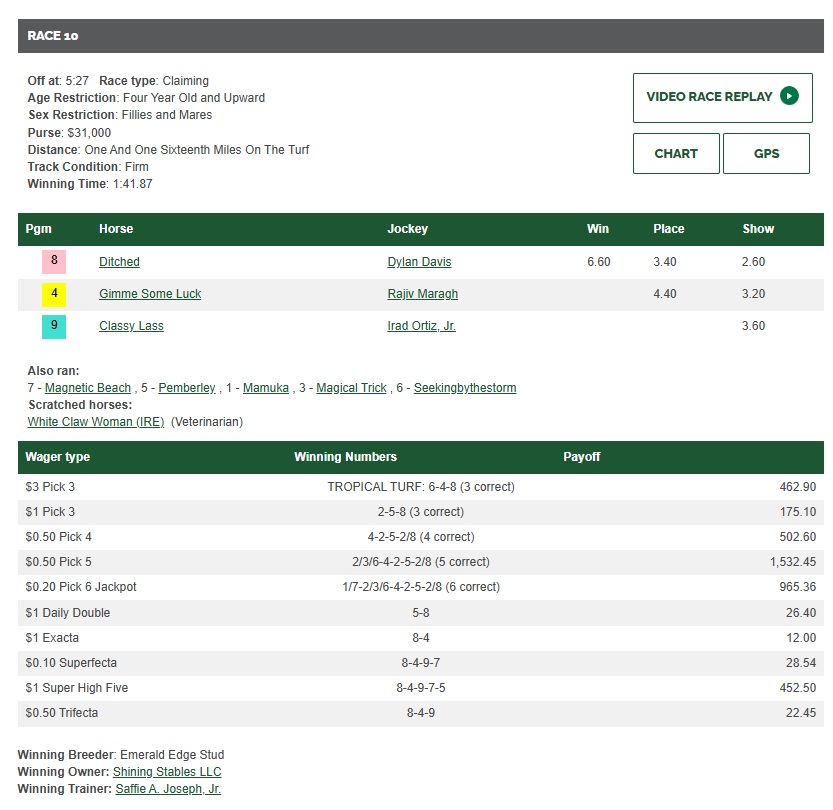
The Track-IQ framework had an excellent result yesterday in the 10th at Gulfstream, a $17.5K claiming race at 1 1/16 mi. on the turf, having the tri-fecta order with its Primary, Secondary and Tertiary selections of #6 Ditched at 2-1, #4 Gimmie Some Luck at 3-1 and #9 Classy Lass at 7-2. In the race, Ditched came wide around the far turn before accelerating down the stretch and catching Gimmie Some Luck and Classy Lass at the wire. The $0.50 tri-fecta paid $22.45. The projections for this race had high confidence due to the low Chaos Index value of only 1.3 and average Field Risk of 9.55%. Ditched is a granddaughter of Unbridled, the 1990 Kentucky Derby Champion, and showed flashes of Unbridled’s excellent late kick and stamina in this race.
In horse racing, the central mistake most bettors make is believing that success comes from simply picking the right horse. The reality is governed by a different principle: the bettor cannot control the outcome of a race, only the price at which risk is purchased. Every race contains uncertainty—pace scenarios change, horses break poorly, trips go wrong, and countless variables influence the final result. Because of this uncertainty, the intelligent bettor must approach racing not as a guessing game but as a pricing problem. Track-IQ is built around this exact theorem. Instead of relying on intuition or narrative handicapping, the system estimates each horse’s probability of winning and converts those probabilities into fair odds. In doing so, it provides the bettor with the one piece of information that truly matters: whether the market price offered by the betting pools properly compensates for the risk being taken.
Most products in the horse racing marketplace never reach this level of analysis. They fall into three familiar categories: past-performance tools that provide raw data but no interpretation, tip sheets that offer selections without mathematical justification, or qualitative handicapping methods built around angles, trainer patterns, or narrative storytelling. None of these approaches fully address the fundamental theorem of wagering because they do not attempt to price the race probabilistically. Track-IQ begins where those systems end. By translating handicapping factors into probability and fair odds, it transforms racing analysis into a structured evaluation of risk. Selections matter only insofar as they help determine probability; the true advantage appears when those probabilities reveal that the betting market has mispriced a horse relative to its actual chances.
For this reason, Track-IQ is not simply another handicapping aid—it is a tool designed to price uncertainty. It applies the same reasoning a capable human handicapper would employ—evaluating factors such as days since last race (DSLR), performance variance, and contextual adjustments—but embeds those judgments within a probabilistic framework that converts them into measurable win probabilities and fair odds.
Over any single race the outcome remains uncertain, but across many races the mathematics of expectation assert themselves. By focusing on probability and price rather than guesswork, Track-IQ aligns perfectly with the governing theorem of wagering: the bettor cannot control who wins the race, but can consistently choose the right price at which to buy risk.
 Pro-Handicap Analytics