The AI-enabled and Fair Grounds customized program had excellent results today, having the winning horse with its P/S/T selections in eight of the nine races covered, including 6 with the Primary selection (66%). Here is the Track-IQ report for FGX, the results and breakdown of the results.
Ahead of the Pegasus World Cup weekend at Gulfstream, the AI-enabled and Gulfstream customized program had excellent results today in the Track-IQ report. The program had the winner in eight out of the ten races (80%) analyzed with its P/S/T selections, including having the winner in four races with the primary selection (40%). Here is the PDF, race results and breakdown of the results.
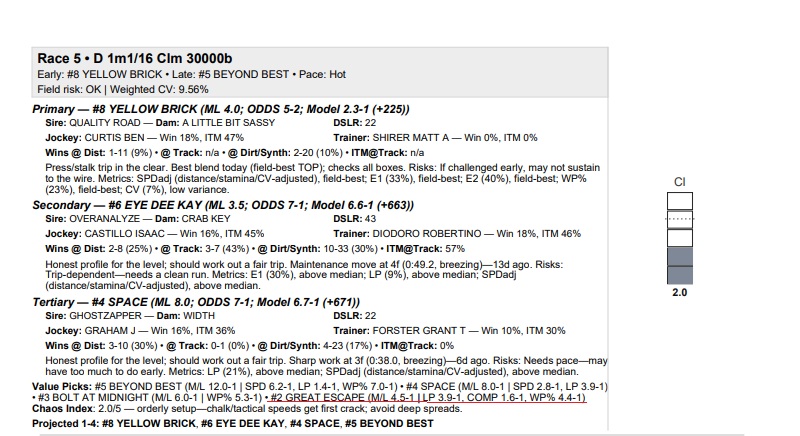
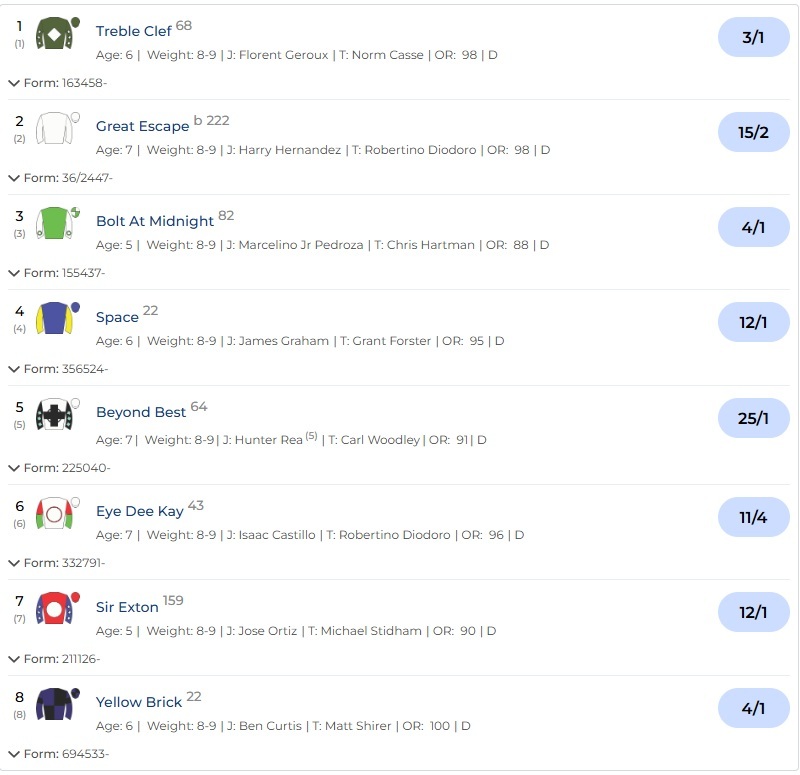
For those wondering how the Image-IQ Report can be used to spot value in horses other than with the obvious Model Odds values, there is a section below the Primary, Secondary and Tertiary selections called Value Picks, in which the user can see how specific metrics of the horse like SPD, E1, E2, LP, COMP and WP% are valued in terms of odds, which are converted from their win probabilities and historical win percentage. Ideally, the user is looking for horses that do not have just one metric, whose conversion to odds is below the live odds of the horse but multiple metrics below. Such a situation appeared in the 5th at the Fair Grounds yesterday, a $30K Clm at 1 1/16 mi. on the dirt with a projected hot pace, with the #2 horse, Great Escape at 9-1. The horse had three metrics with odds conversions not just below its live odds of 9-1 but also below its M/L of 9-2, including “LP 3.9-1, COMP 1.6-1, WP% 4.4-1”. What this means is that the horse’s late speed, COMP as the sum of its E1, E2 and LP probabilities from the simulation and historical win percentage, adjusted for stakes, had values that were below the M/L price. At 9-1, the market was treating Great Escape as a horse with 10% winning chances rather than a horse who has won 18-20% historically against this level of competition. Its COMP value of 1.6-1 indicated better than 2-1 strength for the horse on a speed component level in the aggregate.
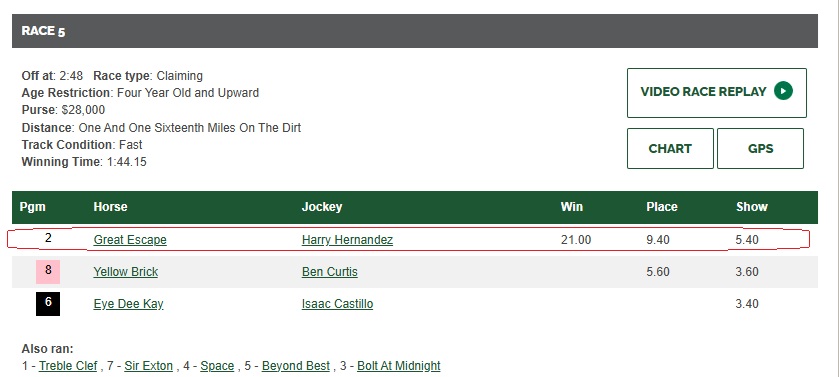
In the race, Great Escape led from start to finish, winning by several lengths. The Primary selection in the Track-IQ report, #8 Yellow Brick, finished second. Great Escape paid $21 for the win and the $1 ex. paid $48.30. This result shows how a quick analysis of the value metrics of the horses can be used to spot a significantly undervalued horse. Pairing this type of discounted horse with the Primary selection is a reasonable exacta strategy that can be very profitable when the heavily discounted horse performs according to his projections and quantitative strength. This race is being mentioned because #2 Great Escape was actually taken in the race and is a real-life example.
The Track-IQ reports for the Fair Grounds and Santa Anita Park will be available today on the Purchase page. Check after 12:00 p.m. CST for the report for Santa Anita.
Here’s the explanation for why Golden Tempo won the LeComte yesterday over the horses that had been identified as Primary/Secondary/Tertiary in the Track-IQ framework.
Golden Tempo won the LeComte because the race unfolded far outside normal Fair Grounds dirt-route parameters, not because he was overlooked or misread. While the model correctly identified him as the strongest late runner, it did not elevate him into the top win tier under baseline assumptions, since horses dependent on late pace typically require help up front. What made this race different was the pace structure. The opening quarter of 23.72, followed by 47.11 to the half and 1:11.89 to three-quarters, created sustained early stress that developing three-year-olds rarely withstand over 1 1/16 miles at this venue.
That pressure didn’t merely soften the leaders—it dismantled second-call control entirely. Carson Street and Crown the Buckeye were forced into an unsustainable rhythm, and once that structure failed, the race flipped decisively to late flow. Golden Tempo, despite breaking slowly, saved ground under a patient ride and produced a last-to-first rally once the pace collapsed. He didn’t outrun expectations; the race exceeded the collapse threshold. Going forward, early Kentucky Derby prep races with comparable internal fractions will receive an alternate pace-stress analysis to reflect their elevated breakdown risk. This adjustment doesn’t replace the primary read or overvalue closers—it clarifies when race structure is fragile, and when late runners become legitimate win threats rather than contingent outcomes.
 Pro-Handicap Analytics