Tag: horse-racing

New Product: Track-IQ Overlay Map

Pro-Handicap Analytics today announced the release of the Overlay Map, a new visual companion to the Track-IQ Report designed to provide horseplayers with a clear overview of the entire field in every race. The Overlay Map is powered directly by the same probability engine used in the Pro-Handicap Wizard software, ensuring that the calculations remain consistent with the modeling that has driven the system for years. These calculations are pro-caliber analytics not found anywhere else, derived through Monte Carlo simulations of 1,000 races to estimate the true winning probabilities of each horse based on key performance factors.

One of the defining features of the Overlay Map is its color-coded shading, which highlights where the system’s core metrics—such as Final Speed (SPD), Early Pace (E1/E2), Late Pace (LP), and composite pace probabilities—translate into implied odds that are shorter than the horse’s Morning Line (M/L). When a metric suggests a horse should theoretically be priced lower than its Morning Line, the shading visually signals that the horse may be undervalued relative to that performance factor. This allows users to quickly identify which metrics indicate potential value before interpreting the live tote odds, using the calculations as a professional reference point while the betting market develops. Additionally, each horse name includes superscript class indicators: ᵘ denotes a horse moving up in class, while ᵈ denotes a horse moving down in class from its previous start.

The Overlay Map also includes a Flag column that highlights potential wagering opportunities. A Buy Signal appears when a horse’s WP% (historical win percentage adjusted for stakes) indicates the horse is trading at a discount relative to its Morning Line expectation. This suggests the horse’s historical win performance implies a shorter price than the Morning Line indicates. In addition, the map identifies Extreme Signals when the discrepancy between the system’s probability-derived odds and the Morning Line reaches a +8 odds differential or greater, pointing to situations where a horse may be significantly undervalued by the betting public.

The Track-IQ Report and the Overlay Map will now be combined into a single PDF, providing users with both probability rankings and value analysis in one integrated product. This combined report will be available for purchase on the website’s Purchase Page, giving users a comprehensive race analysis that shows which horses are most likely to win and where the betting market may be offering favorable prices. Together, the Track-IQ Report and Overlay Map create a disciplined framework for evaluating races through probability, price, and value.

Below is link to the Overlay Map for Gulfstream from March 8, 2026. Already in the 1st race, a $35K maiden race at 1 1/16 mi. on the turf, the Map identified #8 Overseer as being extremely discounted in terms of LP, flagging the horse as such in the Flag Column. It’s strong LP turned out to be the difference in the race, with Overseer winning at 30-1 odds. Also worth noting is that Overseer was the only horse moving up in class while all the other horse were moving down.
A Strong Case for the Track-IQ Approach, Mar. 4, 2026

In horse racing, the central mistake most bettors make is believing that success comes from simply picking the right horse. The reality is governed by a different principle: the bettor cannot control the outcome of a race, only the price at which risk is purchased. Every race contains uncertainty—pace scenarios change, horses break poorly, trips go wrong, and countless variables influence the final result. Because of this uncertainty, the intelligent bettor must approach racing not as a guessing game but as a pricing problem. Track-IQ is built around this exact theorem. Instead of relying on intuition or narrative handicapping, the system estimates each horse’s probability of winning and converts those probabilities into fair odds. In doing so, it provides the bettor with the one piece of information that truly matters: whether the market price offered by the betting pools properly compensates for the risk being taken.

Most products in the horse racing marketplace never reach this level of analysis. They fall into three familiar categories: past-performance tools that provide raw data but no interpretation, tip sheets that offer selections without mathematical justification, or qualitative handicapping methods built around angles, trainer patterns, or narrative storytelling. None of these approaches fully address the fundamental theorem of wagering because they do not attempt to price the race probabilistically. Track-IQ begins where those systems end. By translating handicapping factors into probability and fair odds, it transforms racing analysis into a structured evaluation of risk. Selections matter only insofar as they help determine probability; the true advantage appears when those probabilities reveal that the betting market has mispriced a horse relative to its actual chances.

For this reason, Track-IQ is not simply another handicapping aid—it is a tool designed to price uncertainty. It applies the same reasoning a capable human handicapper would employ—evaluating factors such as days since last race (DSLR), performance variance, and contextual adjustments—but embeds those judgments within a probabilistic framework that converts them into measurable win probabilities and fair odds.

Over any single race the outcome remains uncertain, but across many races the mathematics of expectation assert themselves. By focusing on probability and price rather than guesswork, Track-IQ aligns perfectly with the governing theorem of wagering: the bettor cannot control who wins the race, but can consistently choose the right price at which to buy risk.

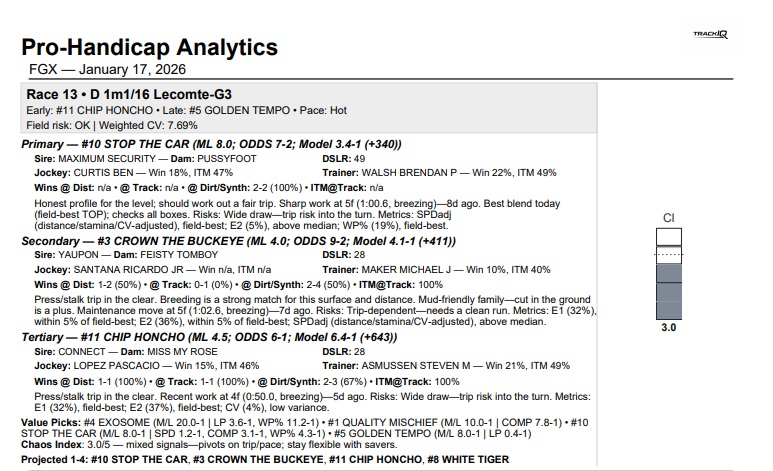
$250K LeComte Stakes Analysis, Fair Grounds, For Sat., Jan. 16

Here is the analysis for the G3 $250K LeComte Stakes at the Fair Grounds tomorrow, run at 1 1/16 mi. on the dirt for three-year-olds. It’s a Kentucky Derby prep race worth Derby 42 pts. total at Churchill, with 20 pts. going to the winner The Track-IQ report for FGX tomorrow includes analysis of the $175K G3 Louisiana Stakes at 1 1/16 mi. on the dirt for four-year-olds.

To see the above image in high-resolution, click on the image and then on the encircled “i” in the bottom right-hand corned. Scroll down and click on the link fur “full-size” in the bottom center.

Race Breakdown

Stop the Car (ML 8-1; MO 3.4-1) – Primary

Stop the Car appeals here because he looks like a three-year-old who is still on the upswing rather than one who has already shown his full hand. He’s undefeated, but the more important takeaway is how he’s won — without being fully extended or chasing inflated figures. That kind of profile plays well at Fair Grounds, where the dirt tends to reward horses who can carry their energy through the lane instead of those built purely on early speed. This race doesn’t require a dramatic leap forward; it typically rewards a horse who progresses naturally at this stage of the season, and his form suggests that kind of steady development.

The projected shape of the LeComte Stakes also works in his favor. Several contenders want to be involved early, while others are dependent on a pace collapse, leaving a tactical horse with flexibility in an advantageous position. Stop the Car doesn’t need the lead, but he also doesn’t need help from a meltdown, allowing him to stay in range while others sort themselves out. That versatility is often the difference maker in this race. The case here isn’t about flash or résumé; it’s about fit, timing, and upside, and those factors line up cleanly for him on this stage.

#3 Crown the Buckeye (ML 4-1; MO +4.1-1) – Secondary

#3 Crown the Buckeye merits serious consideration as a competitor because his profile speaks to durability and adaptability rather than flash. He has already shown he belongs in deeper waters, and that experience can matter in a race where several entrants are still figuring out what they are. His form suggests a colt who can handle pressure and stay on when the race turns from positioning to resolve, which is often where Fair Grounds separates pretenders from contenders. If the LeComte becomes a test of who can maintain rhythm and composure through the final three furlongs, Crown the Buckeye has already demonstrated that kind of staying power.

#11 Chip Honcho (ML 9-2; MO 6.41) – Tertiary

Chip Honcho fits a different but equally legitimate angle. His appeal lies in tactical intent and forward placement without being reckless, a combination that can prove dangerous in a prep where others are either committed speed types or need significant help late. He doesn’t require a perfect setup to be effective; instead, he can secure position, conserve enough energy, and make the field react to him turning for home. In the LeComte Stakes, that sort of race-shaping presence often keeps a horse involved longer than the betting suggests. Together, Crown the Buckeye’s stamina profile and Chip Honcho’s tactical edge give them credible paths to impact the outcome, even if the spotlight falls elsewhere pre-race.

Video on Stop the Car

Aqueduct Card and Results, Sat., Nov. 29, 2025

Here is the Premium Racing Report for Aqueduct today, the results and the grading. The AI-enabled program did very well, having winners with primary selections in 3 out of 8 races (37.5%), including #1 Looms Boldy in race 5 at 8-1.

https://www.equibase.com/static/chart/summary/AQU112925USA-EQB.html

📌 SUMMARY METRICS (Races 3–10 Only)

MeasureResultComment
Primary Win Rate3 / 8 (37.5%)Exceptional for NYRA
Primary ITM5 / 8 (62.5%)Strong board presence
Primary/Secondary Exacta Hits3 major hitsRaces 5, 7, 9
Cold ExactaRace 5Perfect vertical prediction
Major OverlayRace 5 winner paid 18.78Huge model catch
Model Structure IntegrityHighContenders aligned correctly
Chaos/Variance Failures2 racesR8, R10 (expected chaos)

🏅 FINAL GRADE: A-

The model returned results firmly in the professional-tier range, with standout pricing accuracy and vertical predictability in tough, mixed-condition NYRA fields. The A- reflects a card that was highly profitable, logically sound, and exceptionally accurate where it counts most.


🔎 RACE-BY-RACE ANALYSIS


Race 3 — Grade: A

Primary Winner: #7 Higher Force (4.06)

  • Model hit the winner cleanly.
  • Secondary (#3) finished 2nd → Exacta hit (7–3).
  • Contender alignment was perfect and pace call was precise.

Why A: The engine mapped the field in correct order with no leakage.


Race 4 — Grade: B+

Primary: #7 Sassy Princess — 2nd

  • Winner (#1) was a logical Type-2 value horse.
  • Primary finished 2nd; Secondary/Tertiary participated.
  • Exacta was hittable but required saver structure.

Why not A: The Primary didn’t close the show, but the read was good.


Race 5 — Grade: A+ (Best Race of the Day)

Primary Winner: #1 Looms Boldly (18.78)
Cold Exacta: 1–3

  • Primary was a massive overlay (ML 8-1 → model fair odds ~3.2-1).
  • The model nailed the winner and exacta outright.
  • Value Picks supported the structure.

Why A+: This is what elite models do—identify long-priced Primary winners in mid-level claimers.


Race 6 — Grade: A

Primary Winner: #3 Ridgewood Runner (7.00)

  • Clean Primary victory.
  • Secondary (#4) ran 2nd → Exacta hit (3–4).
  • Pace map predicted a controlled stalk-and-pounce trip correctly.

Why A: Clear win + precise vertical alignment.


Race 7 — Grade: A-

Primary: Off the board
But: Secondary → 1st, Tertiary → 2nd

  • Backup layer absolutely carried the race.
  • Exacta hit again (7–8) using Secondary/Tertiary.
  • Chaos rating correctly suggested volatility.

Why A-: Primary missed, but structure was still profitable.


Race 8 — Grade: C+

Primary missed
Race was high-variance (cheap claimers)

  • Winner paid 22.68, reflecting genuine chaos.
  • Model contenders underperformed here.
  • This race type is historically low-predictive.

Why C+: Not a model failure—conditions were inherently noisy.


Race 9 — Grade: A

Primary 2nd, Secondary 1st

  • Secondary (#2) won; Primary (#1) finished 2nd → Exacta hit (1–2).
  • Strong contender placement.
  • No red flags—model read race shape cleanly.

Why A: Order inversion but exact predicted pair.


Race 10 — Grade: C+

Primary missed
High-chaos allowance N1X

  • Winner was logical but still elevated chaos number.
  • All three model tiers missed the board.

Why C+: A known volatility zone, typical for NYRA late-day turf miles and N1X types.


🎯 OVERALL GRADE: A-

Strengths:

  • Elite Primary performance (37.5%)
  • Deep vertical accuracy (multiple exacta hits)
  • One premium-priced Primary overlay winner
  • Stable pace projections across all clean races

Weaknesses:

  • Late-card chaos (R8, R10)
  • Noise-heavy races pulled down raw % numbers
  • Primary misses mainly in claimers + chaos-designated races

Belmont Stakes Preview, Sat., Jun. 7, 2025

Today at Belmont at Saratoga is the $2 million Belmont Stakes, run at 1 ¼ mi. on the dirt for three-year-olds. As the third leg of the Triple Crown, the race features the best three-year-olds in the country, including Kentucky Derby winner, #7 Journalism, Preakness winner and Kentucky Derby runner-up, #2 Sovereignty, Kentucky Derby third place finisher, #6 Baeza, and Wood Memorial winner, #3 Rodriguez. The program has #7 Journalism at 8-5 on the M/L as its first selection with a total win probability of 32.36% (2-1 theoretical odds). Journalism projects first in final speed with a 46.1% win estimate while having the second highest win percentage at 27.9%. Second is Third is #6 Baeza with a total win probability of 17.97% (9-2 theoretical odds). Baeza projects 2nd in final speed with a win estimate of 31.32% while having elevated risk with a Coefficient of Variance of 10.98%. Third is #2 Sovereignty with a total win probability of 17.24% (7-2 theoretical odds). Sovereignty is the class in the race with a win percentage of 36% following his win the Kentucky Derby and second place finish in the Florida Derby. Fourth is #3 Rodriguez with a total win probability of 11.98% (7-1 theoretical odds. Rodriguez projects third in final speed with a 13.4% win estimate while having a COMP value of 28.3%, indicating strength on a component level in the aggregate relative to the field. In the final analysis, Journalism appears in good form for a rematch with Sovereignty after the former’s thrilling come from behind win in the Preakness. The former horse projects first in final speed while also having a strong COMP 55.4% (equating to 4-5 strength). Journalism is coming off only three weeks rest whereas Sovereignty sat out the Preakness and has been off 35 days. With the track expected to be muddy today, Sovereignty may have the edge between the two horses after having defeated Journalism on the wet track by a length at the Kentucky Derby. Baeza is the second selection because of his final speed projection of 31.3%, but the horse finished behind Journalism and Sovereignty in the Kentucky Derby and Preakness. Bob Baffert Trained, Rodriguez, is in a position to be the spoiler today on the back of his win in the Wood Memorial when he recorded a 105 final speed figure. The horse did not race in the first two legs of the Triple Crown because of injury. The final selections are #7 Journalism, #6 Baeza, #2 Sovereignty and #3 Rodriguez.